
History of Billiards

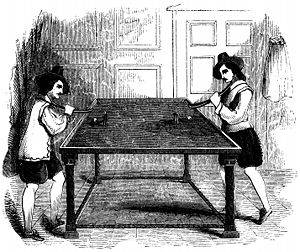 As you're already aware, 520 offers an array of entertainment right below you on the first level. You've probably even wondered over to the Pool Table and attempted a couple bank shots. But have you ever stopped and thought about how Billiards came to be? Every sport has its history. Today you'll find the infamous green table and pool sticks in bars, clubrooms or arcades, but the History of billiards is very long and rich, dating back to the 1500's. Most of our information about early billiards comes from accounts of playing by royalty and other nobles in Europe. But in 1600, the game was familiar enough to the public that Shakespeare mentioned it in Antony and Cleopatra. It evolved from a lawn game similar to the croquet played outdoors, but in the late 1500's play moved indoors to a wooden table with green cloth to simulate grass and a simple border was placed around the edges. The balls were shoved, rather than struck, with wooden sticks called "maces". Tables originally had flat walls for rails and their only function was to keep the balls from falling off. They resembled river banks, and even used to be called "banks". Players discovered that balls could bounce off the rails and began deliberately aiming at them. Thus a "bank shot" is one in which a ball is made to rebound from a cushion as part of the shot. Billiard equipment improved rapidly in England after 1800. Chalk was used to increase friction between the ball and the cue stick even before cues had tips. By 1850, the billiard table had essentially evolved into its current form. Eventually the game made it's way across the Pacific to New England in the late 1800's. The dominant American billiard game was American Four-Ball Billiards. With many balls, there were many different ways of scoring and it was possible to make up to 13 points on a single shot. American Four-Ball produced two offspring, both of which surpassed it in popularity by the 1870's. One, simple plays with three balls on a pocketless table, is something known as "Straight rail".The other popular game was American Fifteen-Ball Pool, the predecessor of modern pocket billiards. The word "pool" means a collective bet, or ante. Many non-billiard games, such as poker, involve a pool, but it was pocket billiards that the name became attached to. The term "poolroom" now means a place where pool is played, but in the 19th century, a poolroom was a betting parlor for horse racing. Pool tables were installed so patrons could pass time between races. The two became connected in the public mind, but the unsavory connotation of "poolroom" came from the betting that took place there, not from billiards. In the 1920's, the poolroom was an environment in which men gathered to loiter, smoke, fight, bet, and play. And by many standards, some could say not much has changed. Billiards saw a popular uproar with two specific events: the first was the release of the film "The Hustler" in 1961 starring Paul Newman in the title role. Poolrooms threw open their doors across America for the remainder of the 60's, but they fell short again as social concern for outdoor coeducational activities launched. In 1986, "The Color of Money" was released as a sequel to "The Hustler" starring Paul Newman once again and the revival was stirred, still long lasting among today's youth. Now that you know the history of Billiards, learn how to play the game like a pro and impress everyone with your skills and whit.